How to read a peptide certificate of analysis
A certificate is a record of one sample on one date by one method. Read in that order, it is informative; read as a badge, it is nearly meaningless.
- Last scientific review
- September 2026
- Published by
- Pure Helix
Field by field
| Field | Question it answers |
|---|---|
| Lot number | Which physical batch does this document describe? |
| Product and labelled strength | What was declared, and at what fill weight? |
| Date of analysis | When was the sample examined? Results age; material changes. |
| Testing laboratory | Who performed the work, and are they independent of the seller? |
| Method and conditions | Column, gradient, detection wavelength — without these the purity figure is not comparable. |
| Identity result | Does the observed mass match the declared molecule? |
| Purity result | What proportion of detected material was the main peak? |
| Content / quantitation | How many milligrams of target compound are actually present? |
| Verification code | Can the document be checked against the issuing laboratory's record? |
Checks worth making
- Confirm the lot number on the certificate matches the lot number printed on the vial you hold. A certificate for a different lot describes different material.
- Confirm the date of analysis precedes, and is reasonably close to, the date the material was released.
- Confirm the strength on the certificate matches the size you purchased — a 10 mg certificate does not characterise a 30 mg fill.
- Read the content figure, not only the purity figure.
- Treat a certificate with no method conditions, no laboratory name, or no lot number as an unverifiable document.
How Pure Helix publishes certificates
Each certificate-backed lot has its own page at /coa/<lot number>, rendered as an HTML document rather than only as a PDF, so the recorded values are readable, linkable and citable. The signed source document remains available to open or download from that page, and the compound-level archive lists every lot we have on file.
Research use
Pure Helix supplies materials for laboratory research use only. Nothing on this page is medical advice, and none of the material described is for human or veterinary use.
Worked example: a real Pure Helix certificate
Below is the certificate issued for lot PH260501 — retatrutide 10 mg, tested by Bioviridian. Select any highlighted field on the document, or step through them in order, to see what the field means and what to check before you trust it.
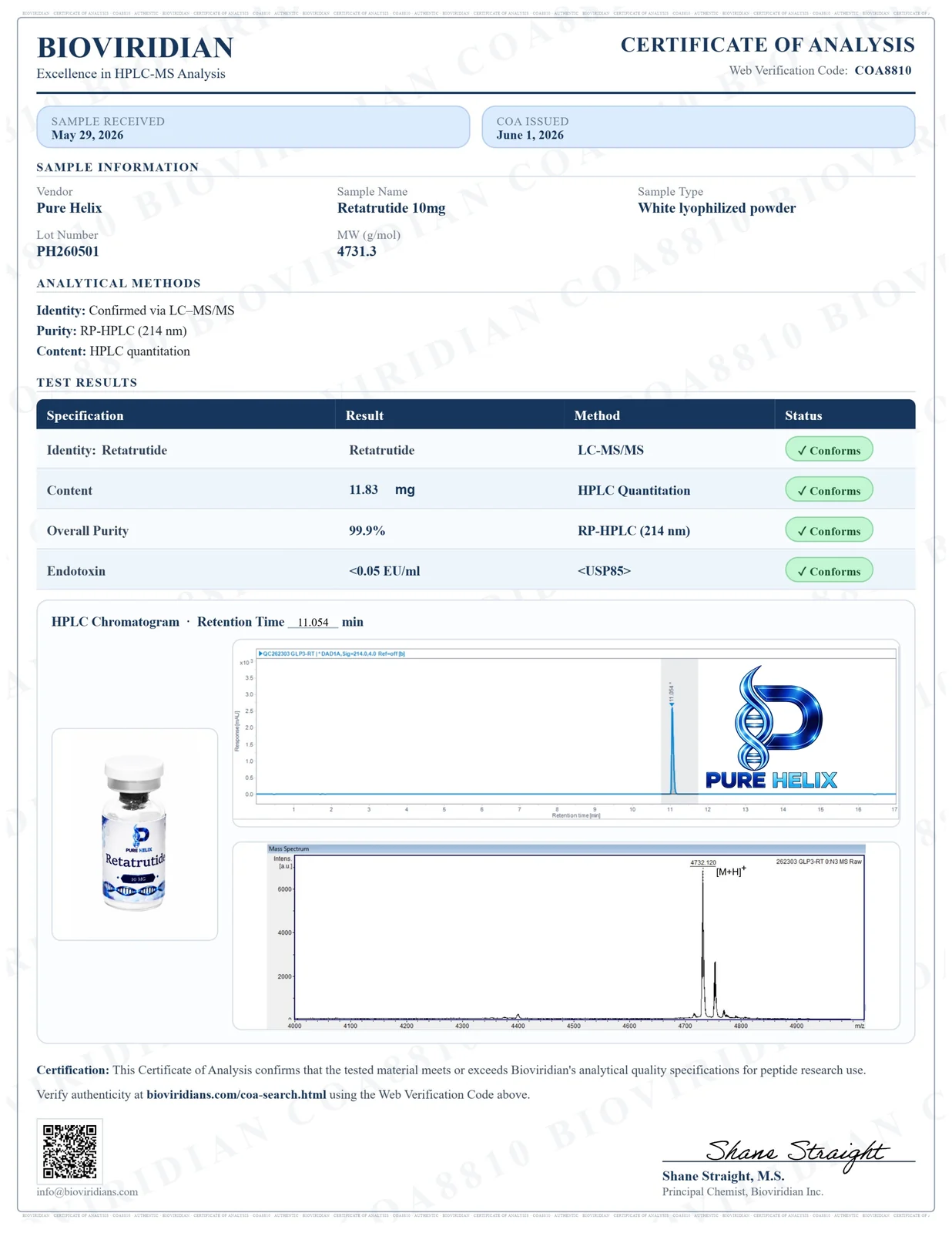
Issuing laboratory
The independent analytical laboratory that ran the tests. A certificate is only third-party evidence if the lab is not the seller.
The lab should be named, contactable, and different from the vendor. Self-issued certificates prove nothing.
On lot PH260501Bioviridian Inc. — the testing lab, not Pure Helix.
Related reading
- Analytical TestingHPLC peptide purity: what the percentage actually measuresPurity by HPLC is an area-percent measurement, not a statement that a vial is 99% target compound by mass. The distinction changes how the number should be used at the bench.
- Analytical TestingHow to read a peptide certificate of analysisA certificate is a record of one sample on one date by one method. Read in that order, it is informative; read as a badge, it is nearly meaningless.