L-Carnitine — molecular reference
L-Carnitine is a quaternary ammonium compound and obligate cofactor for the carnitine palmitoyltransferase (CPT-1 / CPT-2) shuttle, which imports long-chain fatty-acyl groups into the mitochondrial matrix for β-oxidation. In cultured myocytes, cardiomyocytes, and hepatocytes it is used to interrogate fatty-acid oxidation flux, acyl-carnitine profiling, and downstream oxidative-phosphorylation outputs. Presented as a sterile solution ready for laboratory dilution. For laboratory research use only.
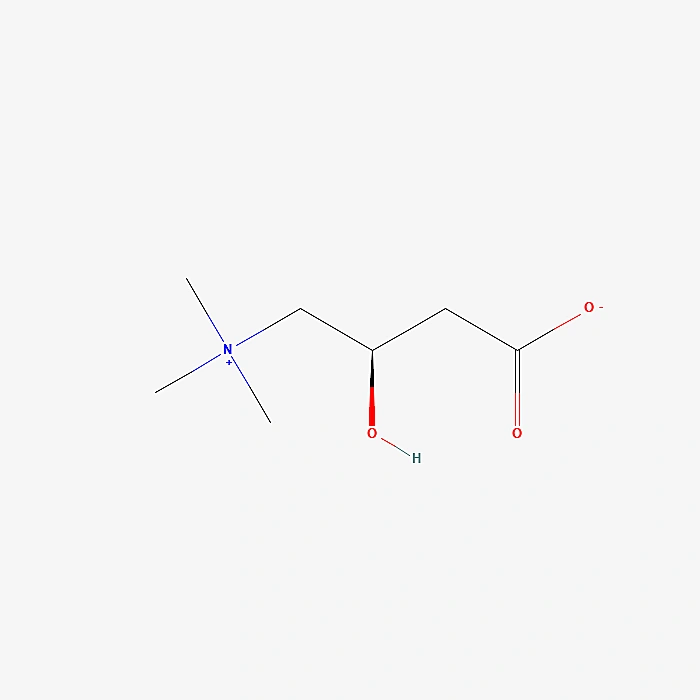
Molecular data
- Compound name
- L-Carnitine (β-Hydroxy-γ-Trimethylaminobutyric Acid)
- Research classification
- Cofactor
- Molecular formula
- C7H15NO3
- Average molecular mass
- 161.2 g/mol(calculated from molecular formula)
- Research pathway
- Cellular & Mitochondrial
- Physical form
- Sterile solution
- Storage & handling
- Store at 2-8°C. Protect from light.
- Available presentations
- 600mg
- Current status
- Backordered
Fields with no verifiable source are omitted rather than estimated. Where an average mass is marked as calculated, it is derived arithmetically from the molecular formula using IUPAC standard atomic weights, not measured.
Documented assay contexts
Contexts in which this compound is used as a reference material in published in-vitro work. These describe laboratory usage, not effects in any organism.
- Long-chain fatty-acid transport across the inner mitochondrial membrane
- CPT-1 / CPT-2 shuttle assays
- β-oxidation and oxidative-phosphorylation studies
Lot documentation
| Lot | Presentation | Purity | Certificate |
|---|---|---|---|
| PH260821 | 600mg | — | Testing in progress |